Technote: Icosahedron Edge Calc

Technote: Icosahedron Edge Calculation:

Geodesic geometry is rather interesting and occasionally quite challenging. I have recently been involved in a project to explore construction options for a structure based on an Icosahedron form. Although the basic geometry was created using Inventor I was curious about the underlying mathematical formulae pertaining to this type of geometry. I also like to be able to verify key dimensions in the 3d model by separate calculation.

One site I would recommend for calculating this stuff is Rechneronline which provides various options for calculating based on known criteria, an example of which I have shown below.

2017-04-20_00-36-10

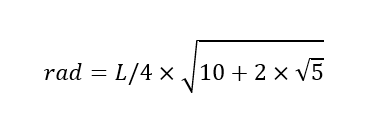
The formula provided are comprehensive but lacking specifically the formula I was looking for to calculate the edge length for a given radius. The fourth formula in the list does include the value (a) which is the Edge Length and therefore can be transposed to determine the value we need.

Here I have rewritten the fourth formula with the value (a) shown as (L) for clarity.
2017-04-20_00-30-49

To determine the value (L) the transposed formula would be thus:

2017-04-20_00-31-02

This is a small snippet of information that I hope may be of some use for anyone interested in Geodesic geometry.  I should note that the 4 is a multiplication of the sum of the parenthesis and not a power to 4 superscript.

To use this in Inventor the formula can be entered as follows in the parameter dialogue box as a user parameter called “EdgeL”:

2017-04-20_02-15-02

The resulting Model value verifies the “d112” dimension from the 3d model.

Project 01: Dome Cabin Concept

Recently I found myself with loads of spare time – I had intended to write a few articles for an online CAD publication, but declined due to communication problems – so I decided to dig up a project that I first thought about doing a few years ago, related to dome structures. This project started out as a study of geodesic structures, tensegrity and synergetics but I never really had the time to develop a viable design.

The structure is based on a 3V dome format with a radius of 56 inches. The main structural elements are timber with hub connections forming the main geometric arrangements. So far I have managed to complete the main structural elements and resolved some of the major connection details, but there is still a lot of base work to do, with further development work required for the entrance.

56 Main Strut Build

I must admit that I am happy with the concept at this stage even though it is at a preliminary stage. It has taken a long time; much more than I intended; to develop this structure primarily due to sizing restrictions as the project is designed for a typical garden environment. I initially started with a 58″ structure and then a 54″ structure but I found limitations in both designs that I was not happy with, consequently the 56″ seemed to be a good compromise.

Sponsorship:

This dome design has been developed using AutoCad Inventor (the actual design units are millimetres). The design addresses many issues concerning the use of panels in conjunction with a space frame that relate to how the 2 structural forms align and merge together to minimise open joints and create a strong structure.

At some stage I would wish to build a prototype for design assessment and to ensure that all the fundamental clearances and accessibility criteria are met. I would be happy to discuss options for sponsorship to help take this project to the next level and build a prototype with eventual intent to manufacture

Dimensions:

  • Floor Area: 5.4m2 approx
  • Overall Height: 2.5m
  • Maximum Outside Diameter: 2.64m
  • Volume: 9.2m3 approx