FW Ta152H: Rudder Development

Fockewulf Ta152: Rudder Model:

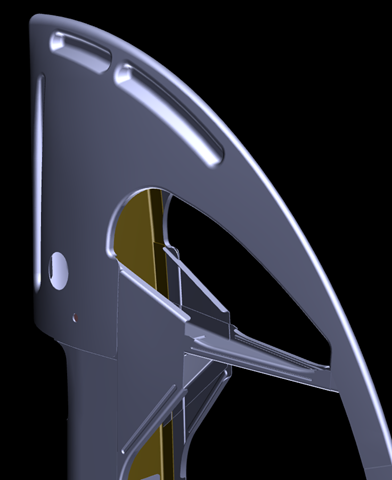
The inclusion of many of the drawings for the rudder section with the scans I received prompted a new challenge for me. It is hard to resist the temptation to actually model this unit in its entirety, although potentially problematic due to the forming of the curved sheet metal elements.

This post has been updated as the previous day by day development process articles have been removed in a blog tidy up!

2009-06-09_2152

2009-06-10_0021

At this stage of the development I have the base structure in place along with four ribs and the components necessary to form the exterior profile. The individual models are fairly basic at this stage, still requiring a lot of detail work to complete them. My primary concern at this time is to check the relationships of each model in an assembly environment and also to derive the necessary interfaces to develop the next stage.

Project 09i: Penultimate Update     Project 09i: Penultimate Update

As I mentioned in my previous posts, the items are initially created from the manufacturing part drawings, which do not necessarily reflect actual ‘as-fitted’ state – so each component has to be developed to suit both criteria. The biggest problem I had with the ribs was with the lower unit that fits snugly between the triangular gussets. The forward part of this rib actually falls at a slope and has an angular bend line for the flanges which is dictated by the upward and outward slope of the gussets. In this instance I created a plane parallel to the inside face of the gussets in conjunction with construction geometry to mark the thickness deviation where the rib intersects with the inward profile of the vertical channel.

You may also have noticed the emboss feature in the ribs – which incidentally is a feature included as standard within Solidworks, my only gripe with this is that it only has one size listed – I will need to read up on the configuration options in Solidworks to create more size options. This also poses a dilemma – there are basically two types of embossing – the deformation of the surface as shown or similar but with a thru’ hole at the bottom – it is not clear on the drawings which is required and consequently I am having to make a best guess at what is required – so for now I will work with the emboss shown until my research can confirm otherwise.

After many days of intensive work I eventually finished the model as shown below:

Project 09X: Rudder Model Finish & Intro…

TechNote #02: SubStation Design Overview using Inventor

SubStation Design #02 21st Feb 2008.

Update April 2010: Fully detailed procedure for using Solidworks or Inventor see: Sub Station Design Overview June 2005

This is a follow on from TechNote #01 which described my recent project to develop a 3d cad strategy for MV and HV substation designs, which encompassed the many aspects of a design workflow that included influential criteria from various sources.

This particular technote is essentially a quick overview of the process when I developed this strategy and I have listed below a number of considerations as an introduction to a forthcoming series of detailed workflow articles

  1. Procurement – the alignment of purchasing with design schedule and availability of vendor data.
  2. TBA – Technical Bid Analysis – the criteria for correct technical bid analysis by the specifying engineers.
  3. Prerequisite data collation and how to manage received data which may include land survey data.
  4. Existing engineering workflow/processes.
  5. Surveying overview – geodetic survey system and bearings.
  6. Modularisation of company structural/electrical standards.
  7. Modularisation of site arrangements, including below ground works.
  8. Modelling hierarchy.
  9. Using external vendor data and third party models.
  10. Document management, naming conventions and cad standards.
  11. Conceptual Design Phase.
  12. Design Engineering Phase.
  13. Deliverable and Design completion Phase.
  14. Reusable aspects, relates to project data that can be reused for future station upgrades/ maintenance and other station design projects.

Once we have established the criteria for all the above we should be in a position to actually start developing the procedures for working with Autodesk Inventor.

  • The actual design process will use Autocad Inventor.
  • What work scope is to be done in Autocad Inventor (Mechanical, Electrical, Structural modelling content) and why?
  • What constitutes a part and what constitutes sub assemblies, assemblies and layouts?
  • How do we develop vendor drawings into 3d models and what rules need to be applied.
  • Developing libraries, parametric models, iparts and features.
  • Bill of Materials – descriptions, format etc etc.
  • Tubes and piping.
  • Electrical Interfaces
  • VB programming.
  • Manufacturing model exchange.
  • Installation and construction criteria.
  • Modularisation of standard vendor supplies – it is surprising how often this is overlooked, if you take the time to find out what constitutes a standard component from a particular vendor and base a design around this you can save considerable money and time.
  • In the 2D context – considerations for coordinate systems, drawing deliverable and future re-usability.

…and so on.. As you probably appreciate the development of a design strategy is dependent on many factors and not just the cad product alone.

Once this cad strategy is implemented it is quite conceivable to create a substation design; whether an expansion or green field site; from concept to drawing deliverable in 10 working days… and if we coordinate our 3d modelling data directly with manufacturing we can also shave considerable time on product deliverable and installation.

TechNote #01: Using Autodesk Inventor for SubStation Design

SubStation Design #01 3rd Feb 2008.

2009-02-25_1220I recently completed a project for a major Electrical Power company in Canada (2005-2007) for which I developed a 3d cad strategy for HV & MV substation design.

This project started in the latter part of 2005 and at that time the best product for what they wanted to do was Mechanical Desktop. The Autodesk Inventor product was considered but the version available then did not have the same level of functionality that we enjoyed with MDT. Today of course that has changed considerably and a lot of the features from MDT as well as a lot of new concepts have been introduced to make Inventor a formidable cad design product.

I should note that this same project has now moved to the Inventor environment.

I mention MDT and Inventor as the main cad products utilised for this strategy, but beyond that I still had to satisfy the criteria and data exchange with the other products used which were AutoDesk Civil 3D and Map 3D. The strategy changed slightly from the MDT concept to align with the DWG exchange capabilities now within Inventor, but overall the main concepts remained unchanged.

Selection of the Cad system was only part of the solution. I spent a considerable amount of time studying the companies engineering practices, the existing library standards and quality control procedures. In addition Procurement, Manufacturing, vendor data and site construction procedures were also studied.

When you put together a cad strategy for any type of project you have to fully understand the company operations and procedures in conjunction with the cad product capabilities to derive a working methodology that works together. In short you are developing an engineering design philosophy that does not impact company business practices.

Modular Approach:

For example this company had a lot of standard assembly drawings in 2d that depicted the various collective arrangements that suit the majority of the different sub station design requirements relating to 44Kv and 230 KV areas, the switchyard, circuit breakers and station transformers. These areas were complete assemblies or layouts and really in that form not conducive to the 3d environment. Requiring only marginal changes I introduced a more modular approach to the company standards by breaking these areas down into manageable chunks of information.

Modularisation actually helped the development of a 3d cad strategy because we could manage the modular units effectively and apply assembly variation directly only to the areas that were affected and not have to deal with large layouts of information that only required localised variation. This was very efficient and as well as helping the file management of these modular units it also provided much more flexibility when it came to designing the substations. The modular philosophy was adopted throughout for many aspects of the project design including land survey data.

Dealing with the company standards was only part of the solution, I also suggested aligning the Procurement schedule with 3D design processes, defined the effective use of survey data, devised BOM solutions for integration with their Procurement systems, developed modelling techniques to improve efficiency (‘smart parts’) and devised VBA applications for the Cad system.

For me personally this was a great achievement, primarily because others had tried before me without success – the problem I believe was that their focus was entirely on the cad product and they had not taken the time to study the entire engineering processes from concept right through to Procurement and construction; without knowing how the whole process works it is almost impossible to devise a solution solely on the basis of an individual cad product.

Furthermore the whole strategy was developed, programmed, designed and devised by myself with no assistance from external sources. I even managed time to assist the Lightning protection chaps adapt the 3d cad to define the areas of influence and protection envelopes.

The Result:

At the end of this project I wrote a manual of over 300 pages that was again broken down into modular volumes to provide access to specific areas of interest. Incidentally when writing any manual it is well worth while considering breaking the subject down into individual subject volumes – this makes it easier to read and the user only has to access a dozen or so pages of data instead of trawling through hundreds of pages.

During the latter stages of the project I demonstrated the potential for the company to design and engineer a complete Distribution Substation in less than 7 days (post concept) which by comparison historically may have taken up to 3 months – a considerable time saving and of course increased efficiency.

The key to the success of this project was simply the understanding of all the various aspects of an engineering design process and identifying the work methodology that could best utilise the capabilities and integration of the CAD systems as part of an overall strategy and not considering the cad systems in isolation.

Please visist BIM Sub Station Web Site for more information and detailed workflows: Design Link

Contact Details:

If you are interested in more information on using Inventor for SubStation design or just wish to find out ways of modularising your own company standards for adapting to a 3d environment then please contact me at hughtechnotes@gmail.com

Project 01: Dome Cabin Concept

Recently I found myself with loads of spare time – I had intended to write a few articles for an online CAD publication, but declined due to communication problems – so I decided to dig up a project that I first thought about doing a few years ago, related to dome structures. This project started out as a study of geodesic structures, tensegrity and synergetics but I never really had the time to develop a viable design.

The structure is based on a 3V dome format with a radius of 56 inches. The main structural elements are timber with hub connections forming the main geometric arrangements. So far I have managed to complete the main structural elements and resolved some of the major connection details, but there is still a lot of base work to do, with further development work required for the entrance.

56 Main Strut Build

I must admit that I am happy with the concept at this stage even though it is at a preliminary stage. It has taken a long time; much more than I intended; to develop this structure primarily due to sizing restrictions as the project is designed for a typical garden environment. I initially started with a 58″ structure and then a 54″ structure but I found limitations in both designs that I was not happy with, consequently the 56″ seemed to be a good compromise.

Sponsorship:

This dome design has been developed using AutoCad Inventor (the actual design units are millimetres). The design addresses many issues concerning the use of panels in conjunction with a space frame that relate to how the 2 structural forms align and merge together to minimise open joints and create a strong structure.

At some stage I would wish to build a prototype for design assessment and to ensure that all the fundamental clearances and accessibility criteria are met. I would be happy to discuss options for sponsorship to help take this project to the next level and build a prototype with eventual intent to manufacture

Dimensions:

  • Floor Area: 5.4m2 approx
  • Overall Height: 2.5m
  • Maximum Outside Diameter: 2.64m
  • Volume: 9.2m3 approx

First Post and Introduction

First post on my Blog. 3rd Sept 2008.

It seems logical that my first article should be an introduction and tell you something about myself:

In my career I have progressed from a draughting apprenticeship in 1976 through 30 years of engineering with over 20 companies worldwide in various positions of responsibility and disciplines. My recent experience is perhaps more prevalent to this blog as it encompasses about 12 years of Cad management and Consultancy for major multi-discipline design engineering companies.

I was fortunate in 1985 to be first introduced to CAD design with a training course I undertook to learn Pafec Dogs – during this course the lecturer received a copy of Autocad – which was amazing as it was capable of running on a 386 PC!. This got me started in a long time association with the Autodesk products from the 2D in the 80s and then 3D in the early 90s through to the present day.

I have always been fascinated with the design and construction of the WW1 and WW2 fighter aircraft. In 2009 I had a lot of spare time on my hands so I decided to search for historical aviation resources to find information that would assist me with my research. Fortunately I came across a number of archive resources and I was able to study and develop some of the fine details of these aircraft utilizing my CAD and engineering skills.

So hence this blog!

In addition to my interest in historical Aviation & 3d Cad I occasionally venture into other fields of engineering, some of which may be featured here.

I hope you enjoy reading this blog.

Best Regards

Hugh